
AUTHOR
Kathrin Meier M.Ost, Registered Osteopath and SIRPA Practitioner
You Are Not Helpless in Your Experience of Pain
When pain or tension has occupied your body for long enough, it can begin to feel like an authority.
It tells you which movements are dangerous.
It tells you what you can no longer manage.
It tells you that something must still be damaged.
It may even tell you that other people are stronger than you—and that you have somehow failed to cope as well as they would.
Those messages can feel completely convincing.
But pain is not an objective narrator.
It is a protective experience. And protection can change.
“I could never do what he did”
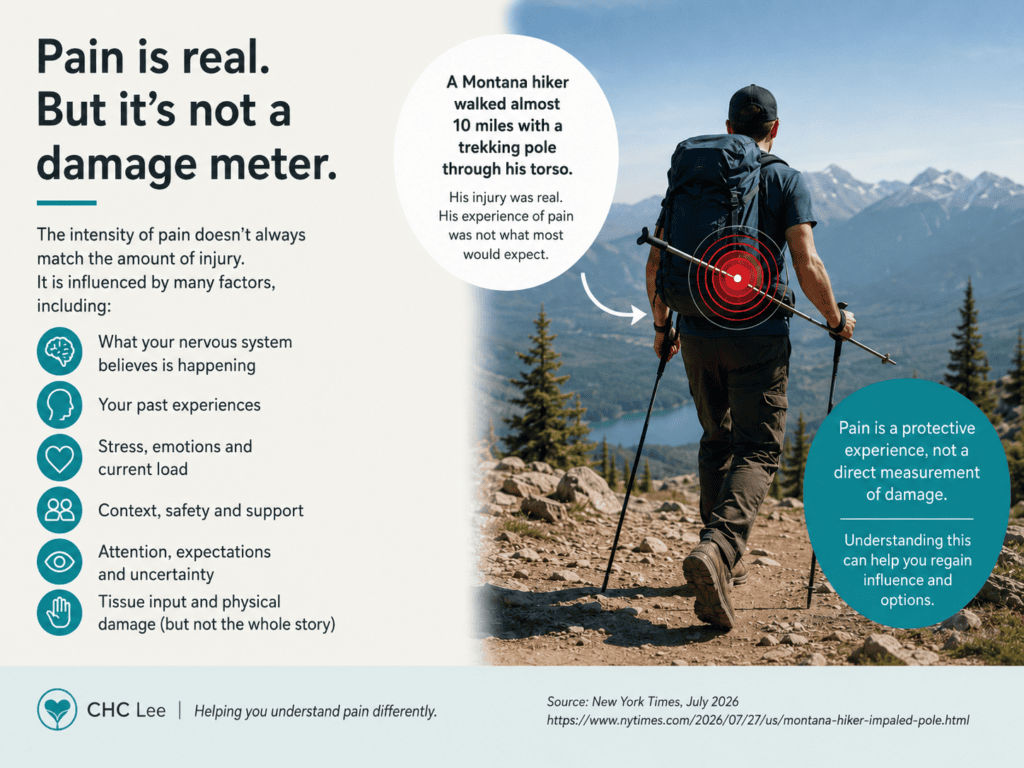
A recent New York Times article told the extraordinary story of David Cifaldi, a Montana hiker who slipped near the summit of Granite Peak and fell onto his own trekking pole.
The pole passed through the side of his torso and emerged through his lower back.
Despite the severity of the injury, Cifaldi remained able to assess the situation and walk approximately ten miles down the mountain with help from two friends. The descent took around six and a half hours. He then received hospital treatment and surgery to remove the pole.
[Read the original New York Times report]
Perhaps your immediate response to reading this is:
“Good for him—but I could never do that.”
That is understandable. But it assumes that he succeeded because he possesses a special level of toughness that you do not.
There is another way to interpret the story.
His nervous system produced the response it considered most useful in that situation.
He was injured and required medical care. Yet overwhelming pain was not the only possible response available to his system.
That matters because your pain is also not a fixed verdict on your strength, character or future.
Pain is not produced on a simple damage scale
We often imagine that the body measures damage and then generates a matching amount of pain.
Ten per cent damage should produce ten per cent pain.
A major injury should produce extreme pain.
No visible damage should produce no pain.
But human experience repeatedly shows us that this equation does not work.
The International Association for the Study of Pain describes pain as a personal sensory and emotional experience associated with actual or potential tissue damage. Biological, psychological and social factors can all influence it.
This does not make pain vague or imaginary.
It means the nervous system must interpret information rather than simply display it.
Your system is continually asking questions such as:
- What is happening?
- How dangerous might this be?
- Have I experienced something like this before?
- Do I need to stop, brace, escape or keep moving?
- How much capacity do I have available?
- How much protection is needed right now?
You do not answer these questions consciously.
The response emerges from everything your system has learned and everything it understands about the current situation.
Your protection is not a personal failure
Persistent pain and tension are often accompanied by shame.
You may believe you are not resilient enough.
You may compare yourself with people who appear to keep functioning despite injury or adversity.
You may have been told that you are too stressed, too sensitive, too anxious or too focused on your body.
None of those judgements explains your experience.
A protective nervous system is not a weak nervous system.
It is a system doing its best with the information and experiences available to it.
Sometimes that protection is well matched to the present danger.
Sometimes it remains high after tissues have healed.
Sometimes it responds to accumulated physical, cognitive and emotional load.
Sometimes uncertainty itself becomes threatening.
And often there is no single cause that neatly explains everything.
If pain is protective, can you control it?
Not directly.
You cannot simply order pain to stop – we wish.
You cannot force your body to feel safe (notice the Oxymoron)
And telling yourself to “just relax” is generally about as helpful as shouting “calm down” at a smoke alarm.
But direct control is not the only kind of influence.
The nervous system learns through information and lived experience.
That means you may be able to influence the conditions in which protection is produced—even when you cannot command the outcome.
This distinction matters.
It moves us away from two equally unhelpful ideas:
“My body is damaged and nothing can change.”
and
“I am creating my symptoms and should be able to think them away.”
There is a third possibility:
Your symptoms are real, you did not choose them, and your system may still be capable of learning something new.
What does nervous-system re-education actually mean?
Re-education is not a technique performed on you.
Nor does it mean that your nervous system is broken and needs to be reset.
It means creating opportunities for your system to update what it expects and how it responds.
That might include:
Understanding what pain means
When every sensation is interpreted as evidence of damage, the body has good reason to remain protective.
Learning that pain can be influenced by more than tissue damage does not remove symptoms immediately. It can, however, reduce some of the fear and uncertainty surrounding them.
Developing a felt sense of safety
Knowing intellectually that you are safe is not always enough.
Your body may still brace, tighten, freeze or prepare for danger.
A felt sense of safety develops through experiences in which the system begins to recognise that it does not need the same level of defence.
Rebuilding trust in movement
Avoidance can be appropriate during an acute injury.
When it continues indefinitely, it may reduce physical capacity and reinforce the expectation that movement is dangerous.
Gradual, responsive movement can provide different information: that the body is capable, adaptable and not as fragile as it may feel.
Recognising overload earlier
Your capacity is affected by more than physical activity.
Emotional strain, decision-making, poor sleep, conflict, sensory stimulation, uncertainty and the effort of continually managing symptoms can all contribute to total load.
Recognising overload earlier creates more options than waiting until the body forces everything to stop.
Developing emotional literacy
Emotions are not separate from the body.
Learning to recognise frustration, fear, grief, anger, pressure or internal conflict can reduce the need for those states to remain unnamed but physically expressed.
This does not mean that emotions cause every symptom.
It means emotional information deserves a place in the whole picture.
Creating new experiences repeatedly
One reassuring conversation rarely changes a long-established protective response.
Learning tends to require repetition.
Each experience of manageable movement, clearer boundaries, recovered capacity, understood emotion or genuine safety can provide a little more evidence that a different response is possible.
How I work at QiBodyWisdom
My work at QiBodyWisdom brings together physical assessment with an integrative understanding of persistent pain and tension.
I am a registered osteopath and SIRPA practitioner, with additional training and ongoing study in persistent pain, nervous-system protection, movement, stress and the body’s responses to emotional overload.
Depending on your needs and whether we work in person or online, our work may include:
- osteopathic assessment and treatment;
- pain education related directly to your own experience;
- SIRPA-informed integrative pain recovery;
- body awareness and movement exploration;
- qigong and gentle movement principles;
- recognising patterns of bracing and guarding;
- emotional literacy and load awareness;
- practical ways to create greater choice, confidence and safety.
I do not assume every pain experience has the same cause.
I do not tell people that their symptoms are “all in their head”.
I also do not promise to reset the nervous system or switch symptoms off.
The aim is to help you understand the whole experience, identify where influence remains possible and create conditions in which your system can begin learning differently.
Who might find this approach relevant?
This way of working may be particularly relevant when:
- pain or tension has persisted or repeatedly returned;
- symptoms fluctuate without an obvious structural explanation;
- medical investigations have been reassuring but you remain symptomatic;
- you have become frightened of movement or bodily sensations;
- stress or emotional overload appears to affect symptoms;
- you alternate between pushing through and crashing;
- you understand a great deal intellectually but your body still does not feel safe;
- you feel trapped in a cycle of monitoring, bracing and trying to control symptoms.
New, changing or concerning symptoms should still receive appropriate medical or physical assessment.
A broader understanding of pain is not a replacement for healthcare. It helps us use healthcare more intelligently.
You are not to blame—and you are not necessarily powerless
There is an important difference between responsibility and blame.
You are not to blame for the experiences that shaped your nervous system.
You are not to blame for the symptoms it produces.
And you are not failing when you cannot simply make them stop.
But discovering that pain and tension are influenced experiences can reveal places where change may still be possible.
You may learn to recognise overload before collapse.
You may respond to pain with curiosity rather than immediate terror.
You may rebuild movement gradually rather than swinging between avoidance and force.
You may understand what your body has been trying to protect you from.
You may develop a sense of safety that is felt rather than merely explained.
None of this requires you to become the hiker who walked ten miles with a pole through his body.
His story is relevant because it reminds us that pain is capable of changing according to context and perceived need.
What you experience today is real.
But it may not be a permanent or complete statement about what your body can become.
Frequently asked questions
Are you saying that pain is all in my head?
No. Pain is experienced through the nervous system, but it involves the whole person and body. Calling pain a perception does not make it imaginary.
Can I control my pain by thinking differently?
Pain cannot usually be controlled directly. Understanding, movement, emotional awareness and experiences of safety may influence the system over time, but this is not the same as choosing whether to feel pain.
Why can pain become worse during stress?
Stress can alter attention, muscle tension, sleep, inflammation, energy, threat perception and available capacity. It may be one contributor among many; it should not automatically be treated as the sole cause.
What is a felt sense of safety?
It is the physical experience of being sufficiently safe—not merely the intellectual belief that you should be safe. It may involve changes in breathing, tension, attention, movement and your ability to remain present with sensations.
Is this work available in person or online?
QiBodyWisdom offers in-person work through CHC Lee in Lee Green, London SE12, and at the QiBodyWisdom location serving Wilmington, Hextable and Swanley in BR8. Integrative pain-recovery and qigong support may also be available online.
Taking the next step
You can learn more about:
- [Integrative Pain Recovery]
- email hellokathi@qibodywisdom.com for more info
You do not need to prove that you are tough enough.
You need support that helps you understand what is happening—and recognise that you may have more options than your symptoms currently allow you to see.
Further reading
- International Association for the Study of Pain — Definition of pain newly updated the first time since 1979!