

Credit: These frequently answered questions have been adapted from a collation by 2 SIRPA practitioners, Georgie Oldfield and Phil de la Haye.
SIRPA is the regulating and teaching body for mindbody practitioners that Kathi, your mindbody Osteopath and Qigong teacher is registered with.
What does the SIRPA approach offer vs a pure Osteopathy approach
Chronic Pain and pain that starts for no apparent reason and or cannot be traced back to tissue damage, has been reliably shown to be a result of unresolved stresses in your life.
For some people the pent up stress can even be traced back to child hood experiences resulting in a chronically overloaded nervous system.
The SIRPA approach teaches you how to identify your stresses, how to self soothe and resolve the root cause of your issues, alongside traditional Osteopathy and medical acupuncture.
The combined approach ensures, we can differentiate between a true physical problem vs a stress related problem.
My pain is so severe, surely it must be due to tissue damage?
I can 100% why you would think that.
Thankfully I have good news - Ready for a revelation?
The amount of pain is not reflected by the amount of tissue damage, if there is any at all.
You could be in agony without any tissue damage whatsoever.
The reverse is true, also, you could have tissue damage and no pain.
There is a vast number of studies showing that many people who do not have pain are found to have degeneration, tendon ruptures and tears, which are often blamed as the cause of pain. How can that be the case when so many people have the same findings, yet they don’t have pain?
The nervous system connects every system and area in the body and we know that the nervous system is triggered by stress and emotions.
For example, we know that fear, anxiety, ruminating and past experiences, all impact the level of pain we perceive.
Pain is not just a sensation but a perception, based on so many factors.
It’s usually related to fear of some sort, such as fear of the pain itself and trying to protect yourself from it increasing, fear caused by catastrophising or trying hard to control the pain, or maybe the fear related to unresolved emotions that are surfacing to conscious awareness etc.
If pain is extreme this means it’s always worth bring your attention out of your head and into your body, maybe initially resting your attention around your heart area and breathing slowly and calmly, preferably through your nose. Once your nervous system is feeling safer, then you could start to explore and address the reasons for the pain increase.
Why have I been fine until now when I am in my 50s, if this pain is linked to trauma I experienced as a child?
That is a very good question. I can see how at a first glance, that may seem rather unlikely. Before reading on, on amazing student of the lasting effects of childhood is Gabor Mate. His books/ audiobooks are well worth reading or listening, too, for a deeper understanding.
Here is a short version of how your childhood can have lasting effects well into your late adulthood:
It's actually fairly simple: we learn coping strategies and behaviours when growing up which help us deal with things in our life, often extremely well. We adapt to our environment to ensure we are accepted and as safe as possible, often sacrificing some parts of ourselves, ignoring boundaries.
Although you might well have been in a low-grade state of fight or flight for a long time, your body will have been protecting you from showing your vulnerability/falling apart throughout this time.
This is likely to have been without you even knowing and feeling normal to you. This might have been through personality traits you learned, such as becoming a goodist, or behaviours such as avoiding confrontation or trying to remain in control.
It’s likely that there were times when your body said ‘no’ when things got too much, like succumbing to a cold or a headache or tummy bug. You might not have been aware of the coincidence of the timing at the time of the symptom onset however, this would have allowed you to back off and recoup until you were feeling stronger.
The signs, the "WHISPERS" have always been there, you most likely haven't been taught how to listen. Eventually those whispers (e.g. tension, colds, cold sores, tiredness, low mood) turn into shouts (pain, stomach issues, poor sleep, allergies etc) as they can no longer be ignored.
The longer whispers are being ignored, even if unintentionally, with everything building up and not being expressed properly, at some point it will spill over, like a pressure cooker.
This often has the effect of making sure you really do STOP and put yourself first for once.
Pain, anxiety, depression, they are all designed to STOP you from carrying on with something that is not helpful to you.
The more dramatic it is, the more likely you will have ignored everything prior to this and you actually need something like this to really make you pause everything in your life.
Once we realise this, it can become a great opportunity to start to consider our own needs and to work on everything that built up to this point.
Do I have to 'do this' forever to remain healthy?
When we begin to put ourselves first and focus on self-care, it can seem awkward and time-consuming.
This is like anything we learn though, until you become unconsciously competent at it, it feels awkward and clunky.
If you have never prioritised your own self-care, then you might feel selfish or you might feel you don’t have time.
Once you experience the benefits though and it becomes more normal, plus you see how little time self-care can take, you will want to continue with ‘this’.
In other words, who wouldn’t want to do what they can to remain healthy, happy and at peace, rather than risk being in the situation they found themselves in when they were ignoring their own needs?
If you listen to the success stories on the SIRPA website, you will hear many of them saying how glad they were to have gone through what they did, because they have learned so much about themselves.
They are actually glad they didn’t just ‘get rid of the pain’ and ‘go back to how they were’, because life had become so much better.
Why am I not 100% yet?
What is 100%?
Pain is a normal protective response of the human experience. If you didn’t experience pain when you stretch a muscle, for example, you might well stretch too far and cause yourself very real tissue damage. So pain is good - it is on your side.
What we don’t want is chronic pain or other persistent symptoms.
Once you gain all the understanding about mindbody conditions and how to ensure your nervous system feels safe, then we are unlikely to develop chronic mindbody symptoms.
This means that if you do have an injury, instead of going into fear and catastrophising, you are less likely for the pain to persist past when the tissues have healed.
Many people tell me that they are only 95% better because they still occasionally experience the old symptom, even though they are able to allow it to calm down in hours and if not hours, days. The neural circuits involved in the pain/symptom don’t dissolve completely though, because they remain dormant. This means that if we go back to our old ways of stressing over things, not prioritising our own self-care and being too busy, these dormant neural circuits can be triggered again.
You then have a choice.
Ignore it, or become fearful and try to carry on, until it forces you to stop!
Or, use it as a learning opportunity to explore why it was triggered and what you can do to prevent it happening again.
The more you use these as learning opportunities and repeatedly calm them down, the less sensitised they will be and the less likely they will be triggered again.
Are you saying this is all in my head?
Have you heard this from your doctors before? Or your loved ones?
They're only half right.
All pain and other mindbody conditions are very real and part of our brain and nervous system’s primal protective response.
So, you more accurate way of say it would be ‘’it's coming from your head, but not all in the mind and it’s not all about mindset either."
What if my symptoms started with a physical injury?
When there has been real tissue damage, the pain will settle down as the tissue heals or when there is no further threat. e.g. once a plaster cast is put on a broken limb, the pain calms down pretty quickly because the plaster is protecting the fracture, so the brain doesn’t require the pain to do this.
If the pain persists after the tissues have healed, then this is usually because the neural circuits have become learned and then sensitised.
Having said that, if the pain began after undertaking an activity you usually do without any problem, then it’s worth considering what was going on at the time and how you were feeling etc. e.g. picking something up off the floor, turning over in bed or even playing tennis.
Alternatively, it might even have come on while playing a sport or doing an activity you usually do and you are trying to find a reason for the pain. This might be because the pain came on afterwards or it came on without you being aware of doing anything awkward.
We will check to see if there is any sign of tissue damage (redness, heat, swelling and pain).
If there is, we will take "first aid" measures to help the pain settle down when the tissues start to heal. We can help speed the comfort along, but do know, healing takes time and true injury cannot be "healed" from the outside (i.e. by an Osteopath).
If there is no sign of tissue damage, also consider and address any psychosocial factors, plus be self-compassionate and gradually start to do more and more.
One amazing piece of knowledge - visualising the tissues healing has been shown to be very effective, whether or you have actual tissue damage or not. How cool is that!
How can I be sure there’s nothing more serious wrong with me?
If you have seen your Doctor and had tests/scans and anything serious has been ruled out, then that’s great. If you haven’t had tests, as an Osteopath we can do certain tests and safety checks also. Osteopaths are first contact practitioners, which means we are trained to rule out disease before treating physical condition.s
Having ruled out any serious conditions (via tests or your medical professional having examined you and there being no cause for concern), your SIRPA Practitioner can help rule in a mindbody/PPD condition using Dr Schubiner’s FIT criteria.
How long will it take to see progress?
This varies from person to person. If you are someone who has an epiphany when reading the books, from seeing yourself and your experiences in the explanations in the book, you may well see real progress straight away as your fear eases and your nervous system starts to feel safer.
If you are living with extreme stress, then it might be that it could take longer as you begin to either change your circumstances and/or learn to address and reduce the impact it has on you.
If your personality traits and learned behaviours play a big role in causing self-induced stress, then progress will increase as you begin to identify and address these.
If you live in your head and catastrophise, ruminate or over-analyse a lot, this can also slow down any progress, so these need to be targeted.
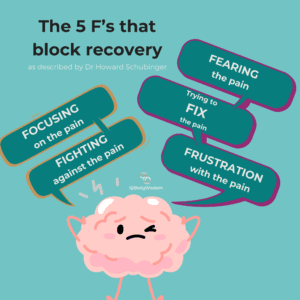
Working on Dr Schubiner’s 5 F’s can help increase progress as you start to identify and address any Fears, doubts and Frustrations, as well as reduce the amount of Focus you put on the pain/symptom and learn to not Fight it or keep trying to Fix it.
What if I don’t consciously feel stressed or anxious?
That is a very fair question:
It is common for people to say they don’t feel stressed or anxious, which just shows they have adapted well to their way of life.
One nice quick way is to check your breathing - how long does an inbreath last for you? 1 second? 2 seconds? Well, it should naturally last 5 or 6 seconds. the further away from those 6 seconds you are, the more likely it is you are stuck in stress mode and didn't even know it.
Unfortunately, the pace of life and the way we live our lives has become normal for us, with our deadlines, lack of communication, excessive screentime, lack of exercise, processed foods etc. That doesn’t mean it’s good for us though!
Checkout Dr Gabor Maté’s book, The Myth of Normal, where he explains this beautifully - amazing read or listen.
If your body is giving you signals in the form of pain or other symptoms, then clearly your system is feeling stressed and under threat, there is no doubt about it.
I know this is neuroplastic pain, I know there is nothing physically wrong, I am doing journaling/breathwork/(insert other ‘work’ here!), so why do I still have symptoms?
This can be due to a number of things. Are you someone who is using the suggestions and strategies to try and ‘prove’ you have or don’t have neuroplastic pain? Are you someone who keeps researching more and more, again to try and prove the concept and its relevance to you and your situation? Are you still fighting the pain or frustrated, or still focusing on the pain and fearful about what you can or can’t do, and trying to fix it?
Also, evidence shows that Alexithymia, which is the inability to recognise or feel emotions, is very common in people who have chronic pain or other chronic health conditions.
You might well know intellectually everything there is about the concept and approach, but how aware are you of how you are feeling? How good is your felt sense/interoception? This is sometimes critical in really making progress.
I have symptoms that are not pain, (fatigue, dizziness, weakness, numbness, tingling etc) does this still all apply to me?
Absolutely. Chronic stress impacts not just our nervous system but also our immune system and the results can be seen in every area of our body.
If your symptoms are persistent or recurring and anything serious has been ruled out, then you can treat it as a mindbody condition. If you are reading one of the books in our field, just replace pain with whatever persistent symptom you are experiencing.
We all have emotions and are impacted by stress so, even if you do have a diagnosed health condition, you can always benefit from following the advice for treating a mindbody condition because it can be used alongside medical advice as part of a whole person approach to help calm your symptoms.
I’ve had my symptoms a long time, is it too late for me?
I'm very sorry to hear you have been suffering for so long.
Amazingly, it’s never too late. That is because mindbody conditions are not tissue damage that gets worse with age.
Mindbody symptoms are cause by learned neural circuits that have become sensitised. As the brain is neuroplastic, it means that it can change so, just as you can learn an instrument, you can learn not to have the pain/symptom.
I was doing really well and now it all seems to have gone to pot and I can’t seem to get to grips with what was working so well for me before. Was I kidding myself?
Not at all. It’s likely that you have gone back into your old learned, unhealthy behaviours and patterns and that fear and doubts are causing symptoms to recur and persist.
Step back, be kind to yourself. Take time out to explore what’s going on and spend time practicing emotional awareness and meditation, plus self-compassion. If you continue to struggle, it could help to reach out to a SIRPA Practitioner who could help you identify what’s going on and provide support and guidance to help you learn from this experience and progress again.
If we are in pain when exercising should we push on as it’s only the brain? Or are we risking actual injury. So how should we move when it hurts - stop or carry on?
If there is no tissue damage, then exercising gently cannot make things worse. Having said that, especially if there is tension in the fascia and musculature, I would suggest gradually starting and allow things to ease up. I would also never recommend anyone ‘pushes’ through anything because pushing causes resistance, both physically and emotionally. Consider this as self-compassionately encouraging yourself to gently exercise and to increase as your confidence and ability improves.
We can explore together how to gently explore movement and gradually increase your zone of comfort.
Visualisation can really help too, by imagining yourself undertaking the exercise freely and with enthusiasm and joy. Really notice how good it feels as you imagine yourself doing the activity, maybe in various different scenarios or places. This really helps you reprogramme your brain to see this as safe, before you start doing it physically.
Athletes DO THIS, too - if your brain knows what to do and how to feel about it, your body will follow.
If you are exercising and pain comes on, I would suggest you slow down or pause, in order to allow yourself to notice how you feel, rather than just ‘pushing’ on and ignoring how you feel. Consider whether you are putting yourself under pressure to get started, be as good as before, to recover or to complete a certain distance/time/weight.
Practicing the pause-breathe-feel-reassure strategy can really help here. See the question below too.
Should I push through the pain?
We get asked this a lot, usually in relation to physical activity/exercise as in the question above, but it can apply to any trigger. We would suggest that you want to try and find the sweet spot between making progress (without ‘pushing’ and creating resistance), and not challenging yourself at all.
Pain is a warning signal. So, when you experience pain around exercise there is often a part of you that perceives exercise as dangerous to you in some way. This danger may be due to a physical injury if it is acute pain. However, in the case of chronic/persistent pain, there is no injury, although there may well be fears related to a previous injury and reinjuring yourself.
Pushing against something always results in pushback, so we would suggest that you don’t consider this as pushing through anything. It’s more about allowing yourself to do more, as and when you feel safe enough to do it. This is because the more fear there is, the more pushback you will have from your nervous system trying to protect you. Ideally identify and address any fears first and then rationalise them with what you now know and any insights you have gained from your own experiences.
Using self-compassion and supportive self-talk, alongside visualisation can help here as you reprogramme your nervous system to accept the exercise/trigger as safe. Practicing the provocative testing exercise and the SIRPA Reframe strategy can help with this and gradually you will feel more able to do more, without forcing it. Give yourself lots of reassurance that the pain isn’t due to an injury – it’s just being created by your brain.
Mindset plays a role here too, so it’s fine to do more or go further etc, as long as you are able to maintain a positive mindset and ensure you are feeling safe. It’s worth noting that it’s also helpful to maintain some somatic awareness afterwards to jump in if unconsciously you start to worry later.
This might be while relaxing in the evening, maybe when habitual worrying starts that you have done too much, which can then become a trigger for more pain, which has nothing to do with what you have done physically.
If pain is intense and you do push through it without addressing your fears, you’re likely to just make yourself feel even more fearful, and any inner part of you that is creating the pain is only going to try harder to stop you from exercising. This is more likely to cause you a setback than help you make progress.
However, if you always let any pain stop you from doing things that expand your comfort zone, then you will stay stuck. Your brain needs to learn that the sensations in your body are safe, and it won’t learn this unless you let yourself do things that bring on those sensations.
How should I go about resuming/increasing physical activity when I am recovering from chronic pain? Gradually or go all in?
For some people going all in can work, but generally I'd recommend building up activity gradually. I say this, NOT because there is something wrong with your body, but because your nervous system is likely to freak out on you if you try and run before you can walk. Literally!
I think it can be helpful to view reintroducing exercise as gradual exposure to a trigger for your nervous system. Be gentle and kind to yourself, listen to your body. And try and make whatever activity you are introducing enjoyable and fun for you. Bring some lightness to it.
When I was starting to run again early in my recovery, I found it helpful to remember how much I loved running for fun as a child. I visualised myself running with my childhood best friend beside me, barefoot and running for the joy of moving rather than for some random fitness goal. I stopped when I got tired, rested, enjoyed the scenery and started again when I felt like it. Sometimes I'd switch to walking if running didn't feel good that day.
I let go of any pressure or expectations about speed or distance. These things helped me so much. Try applying these principles to whatever exercise you are trying to reintroduce
If I don't have a physical injury, why does exercise cause pain?
Exercise triggers mindbody pain for two reasons:
- Because it's a conditioned response
- Because it’s triggering some unconscious emotional response or conflict between different parts in your system
In both cases your nervous system perceives exercise as dangerous, and you need to teach it that exercise is safe.
A conditioned response means your expectation of pain (even if this is unconscious) is activating the pain fear cycle and often merely just using that part of the body (even if just in a particular way) can trigger a reaction. Fear that exercise will cause pain makes your brain create the pain (because pain is a danger signal from the brain).
You can deal with this by gradually increasing the amount of exercise you do. At the same time use lots of self-soothing, self-talk, affirmations of safety, visualisation etc. Tell your unconscious brain you’re fine and demonstrate it with self-soothing, and it will turn down the danger signal.
If exercise is creating unconscious emotions or conflict, it can be helpful to allow this to come into conscious awareness.
Try exploring the different beliefs, expectations and thoughts that come up around exercise. What is your internal chatter like on the subject? Is there a part of you that’s competitive? Is there a critical voice that berated you for not running far/fast enough in the past? Have you ever used exercise to control your weight or try and change your appearance? Is there any unconscious resistance, shame, or fear of failure that might be driving symptoms?
Once you work out what’s going on, you can address the emotions that might be causing the symptoms.
How can I learn from my triggers?
Although it is often a distressing experience when we are triggered, our triggers can be clues that help us unravel what’s going on inside our mindbody system.
What was going on leading up to being triggered? How were you feeling? Is there a theme to the triggers that was learned as a result of experiences in your past that caused you extreme distress? For example:
- fear of abandonment or perceived rejection (even just someone not responding to a message can be a trigger if this is a theme for you)
- responsibility and the frustrations and anger that can remain unrecognised, especially if you are a goodist
- not feeling valued
- not fitting in, etc
Coming to understand that those feelings came from a part of you that was very young, and being curious about why you felt that way, can help you be more self-compassionate about it, plus less ashamed of any strong emotional reactions. These are often emotional reactions of a toddler and rooted in childhood wounds. Therefore, by bringing them to conscious awareness and making links between them with issues that are often more minor, can help you then address them.
By taking better care of yourself, being more self-compassionate and more understanding of these triggers, there is less need for you to be triggered. Remind yourself, “I am safe. I am loved. I am enough.” What clues are your triggers giving you about your internal world?
Is it normal to feel more anxious when other symptoms start to improve?
Absolutely. It doesn’t happen to everyone, but it does happen to a lot of people.
The mindbody symptoms you’ve been experiencing have been expressing your anxiety and distress through your body. They’ve also been a distraction and a focus for your anxiety. When you’re busy worrying about your migraines/backache/pelvic pain, you don’t have much headspace left for worrying about other things. So, it makes sense that when your symptoms start to calm down, you may well become more aware of anxious feelings for a while.
Also, if the emotional work of journaling, coaching or therapy is part of your healing process, remember that you’re turning towards a lot of difficult emotions that you’ve been suppressing/avoiding for a long time. You’re opening that ‘can of worms’ that had been sealed shut. So of course, your nervous system will see that as a threat, and increased anxiety can be a result.
Finally, from a nervous system perspective we can view chronic pain or fatigue as a chronic freeze response.
And when we come out of the freeze response, we naturally move through the highly activated state of fight or flight before we gradually transition towards a calm state of rest/digest/connect.
The increased anxiety that some people experience as part of recovery is their nervous system coming out of freeze and moving through fight/flight. It’s normal, and it will pass if you keep doing the work.
Is it OK to journal about my symptoms
Very good question, especially because we teach not to focus on the pain or problem too much.
It is natural for there to be some confusion about the concept of focusing on symptoms and what that means, and when it might be helpful or unhelpful.
It’s absolutely okay to write about your emotional response to your symptoms, and to write about how your symptoms impact your life, and all the things you're feeling because of that.
The whole point of journaling is to feel and express your feelings. And the experience of having chronic symptoms is a huge stressor in and of itself.
Some people with a long history of chronic symptoms may also have a lot of medical trauma, which needs to be processed.
Ignoring the feelings you have about that isn't going to serve you because it would be repressing yet more stuff. So it is completely okay, and often very helpful to write about how you FEEL about your symptoms.
For example: How have they impacted you? What are all the different emotions you have about that? anger, fear, grief, shame? (probably all of these and more).
And as you write about all of this, try and bring loads of self-compassion to the process. Of course, you have a lot of feelings about the symptoms you've been experiencing. Having chronic symptoms is truly awful, especially when you're in the thick of it and have no hope for recovery - and many of us were in that place for a long time (and still are when we begin a mindbody approach).
Having said that, it can also be helpful at the end of this journaling, to journal about what you are learning about all this, what you are finding helpful etc and exploring things you feel grateful for. This helps you raise your mood after journaling.
Is it normal to for pain to increase when I first start doing deep emotional work in therapy or through journaling?
YES! 100%!
It is totally normal to experience an increase in symptoms when you first start engaging with mindbody healing work. Think about it. Your pain is being produced by your brain because it believes you’re in danger due to all the emotions you’re repressing.
It therefore makes complete sense that symptoms can sometimes dial up when you start turning towards all those feelings you’ve been pushing away for so long, allowing them to come to conscious awareness.
It’s also quite common for old symptoms to pop up again, or for sensations to move to new parts of the body that haven’t been affected before.
Remember, your symptoms are also protections so when changing things up and introducing NEW things, your brain doesn't know what to expect - so it might try and protect you temporarily from the NEW thing, that it doesn't know much about, and the NEW thing is also asking you to look at everything you have been repressing and hiding so far - that can be a TEMPORARY disruptor all by itself.
Your brain and nervous system can try all sorts of things to create resistance to doing the work if the surfacing emotions are being perceived as being a threat.
Q: So what do I do about it? A: Keep calm and carry on!
Easier said than done of course but keep self-soothing and telling your brain that you’re safe. They’re only sensations - They won’t kill you - They will pass.
But your brain just doesn’t know that yet - you are only just starting to learn how to feel safe and connected again.
Do I have to journal about my past to recover?
I believe (based on research and other practitioner's experiences, big names, like Gabor Mate ) most people benefit from investigating their past in order to understand their own personal triggers, and the trauma responses/patterns being played out in the present.
Journaling is an effective way of doing this, particularly if working with a therapist or a coach isn’t possible for you.
We often recommend doing work on three areas:
- past stressors
- current stressors
- personality traits
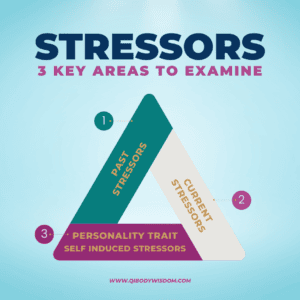
Examining this triad allows you to develop self-awareness, which is key for healing.
When you can understand your present day stressors and triggers in the context of your past experience, they make so much more sense. And when you understand your personality traits and behaviours as learned coping strategies (or responses to past stressors/trauma) it's much easier to develop self-compassion, which is a fundamental part of healing.
Not everyone needs to spend months journaling about past events. But we suggest that everyone would benefit from doing enough work on the past to have an understanding about how it has shaped them, and how those past stressors are still causing issues for them now. Once someone has that understanding they can focus on dealing with current stressors, because they will then be able to understand why they cause such powerful emotional reactions and therefore be able to address those in the present moment.
How is journaling going to help me recover from chronic pain?
It might sound like a weird way to try and help your pain symptoms, but emotional journaling can be a powerful way to dial down your ramped up nervous system, which will then have the effect of turning down the dial on your symptoms too.
When we suggest journaling, we don’t mean just writing about the events of your day like a report. You can read the tips on journaling, but for now it can be helpful to use a form of stream of consciousness journaling, like an emotional brain dump. Let yourself rage, cry, or write your worst fears down and allow the feelings that come up.
If it feels too much, you can always stop for a while as you calm your breathing, ground yourself and/or use some of the self-soothing strategies you have learned. Afterwards it can be helpful to put your hand on your heart and offer yourself self-compassion. Forgive yourself for whatever comes up and maybe consider what you have learned from it, showing gratitude for that.
You can write on top of your writing, or you can delete/destroy your writing when you’re finished. Doing this helps you to feel safe enough not to censor yourself as you are writing and to free-write from the heart.
Regular journaling can really help release cumulative stress. It can also help you develop more self-awareness and more self-compassion. This is because you’ll be listening to yourself and learning about yourself, instead of stuffing down all your feelings and ignoring them.
Journaling is a commitment to yourself and an act of true self-care, and it can be a powerful tool in healing from chronic pain or other stress related conditions.
Is it OK for me to journal about the same thing over and over?
Yes, it’s absolutely OK.
Many people find they return to the same topics, multiple times. Some things need to be explored more than once or written about from different angles before you’re ready to let it go.
For example, you might want to use unsent letters to and from people, including your younger self. Other times you might want to just offload whatever is in your mind at that moment as a stream of consciousness way if you have been triggered.
Also when there are some significant things in the past you need to process you will often find that all roads end up leading to those issues, even if you start out journaling about something in the present. If this happens, that’s fine. Journaling helps you to make these connections between past stressors and current triggers, and this new self-awareness is an important part of the healing process.
However I would also add that if journaling about a particular topic causes you a lot of distress and you start to feel stuck in a loop of rumination or re-living a trauma, then it might be helpful to consider it from another angle in order to help you move on.
For example, it can be helpful to consider it from another person’s view, as if you were them, plus what you have learned from it all. You can’t change the fact it happened so, having acknowledged and expressed how you feel and felt, it’s then about exploring how you can learn from it, rationalise, let go and move on.
If this is still a struggle, it might be helpful to seek the help of a therapist to help you process things further.
Why do I resist journaling/meditation I know it's good for me?
It's the same old battle of short term comfort vs long term peace.
It’s normal to have parts of us that resist self-care. The whole world is set up to provide short term-immediate relief. Alcohol, TV, phones etc.
Resistance happens because we know that when we journal, difficult stuff might well come up. Our default has always been to avoid feeling things, so of course there are parts of us that resist and procrastinate as a defence against feeling vulnerable and worse still, showing our vulnerability.
Who wants to spend twenty minutes sobbing their heart out, or feeling intense anger, or riding out a wave of nauseating shame when the alternative is to NOT feel it?
Watching TV, doing some laundry or drinking half a bottle of wine instead seems like a far more appealing option in the moment when we need to make the choice!
This is why we can benefit from repetitively reminding ourselves that there is a benefit to this healing work. FEELING OUR FEELINGS WILL SET US FREE! It will reduce our symptoms and improve our physical and our mental wellbeing.
But it’s tough when we’re faced with that choice every day: to let your feelings rise or to stuff them down and ignore them. The latter is the easier option and the short-term gain.
So be curious and practice somatic strategies (e.g. Pause - Breathe - Feel - Reassure) to develop your felt sense to help you understand and practice self-compassion about it. Recognise that this work might be simple, but it can often be challenging. Try and be kind to yourself about your avoidance. You’re not failing if you struggle to be consistent.
How do personality traits contribute to my pain/symptom
There are many personality traits that people who experience chronic pain and symptoms seem to share.
The need to be good can create huge self-induced pressure. This is because goodists learned early on that they need to be perfect and helpful to everyone.
They have often learned to be non-confrontational and have poor boundaries, as they put everyone else first, resulting in them also being extremely adaptable to fit in with others.
Not surprisingly, this can lead to a lot of unconscious resentment and anger and, as a result of this they don’t feel good enough and experience guilt, shame and self-criticism. All of which they learned to repress because they are ‘nice’ people. Fear of failure also often keeps you small and stops you from growing. It can lead to you feeling trapped and helpless.
The need to over-analyse and to control ourselves, other people or situations is driven by fear and anxiety. Attempting to control outcomes and people is self-defeating because you can never control the future, or other people. Trying to do this only leads to frustration/anger/more anxiety when you inevitably “fail”.
The internal conflict caused by these kind of traits creates masses of stress - very often at an unconscious level - and keeps your nervous system stuck in fight or flight mode.... and that's what predisposes us to various stress-related symptoms and syndromes, including chronic pain.
How and why should I journal about personality traits?
- In the mindbody world we recognise that those of us who experience chronic pain and other symptoms often tend to have some similar personality traits.
Some of the common traits are: people pleasing, caretaking others (and neglecting ourselves), perfectionism, a need to control (ourselves and/or others), over-analysing, judgement and criticism (towards the self and/or others). These traits can cause a lot of invisible, internal stress because of the way they affect our thoughts and behaviours.
For example:
People pleasing usually leads to poor boundaries and putting other people’s needs before your own. This can generate a lot of unconscious anger and resentment.
Perfection is impossible, so perfectionism sets you up for disappointment. It can result in you feeling constantly frustrated and ashamed, or criticising and judging yourself (and others) for not being good enough.
The need to control is driven by anxiety. Attempting to control outcomes is self-defeating because you can never control the future, or other people. Trying to do this only leads to frustration, anger and more anxiety when you inevitably ‘fail’.
Journaling can be a way to help you explore these traits with self-compassion and to really see how they are adaptive strategies that are your brain’s way of trying to protect you. You can consider when you adopted these patterns, and what was going on in your life at the time. It's then also worth exploring how they are causing yourself stress now and learn to notice when these parts of you get activated. When you start to understand them better, and are able to have more compassion for yourself, there is usually a softening, and the patterns become less rigid and fixed.
Can I change my personality traits such as self-criticism, perfectionism etc?
Yes! These personality traits may not disappear completely, but they can soften, shift and become less of a driving force in your life.
The process of journaling and mindful awareness with self-compassion helps with personality change in much the same way that therapy does.
By developing curiosity about your patterns of thinking and behaviours, as well as how you relate to yourself and to others, you open up the possibility for change. When we try to understand and accept these traits in ourselves, we stop fighting them, and then they will naturally soften and stop working so hard. By developing your felt sense, you can also become aware more quickly when your buttons are pressed so you can change the response, away from the old automatic reaction.
Personality change can be explained in terms of neuroplasticity - i.e. the brain rewiring itself. So, in the same way that we can learn pain-free circuits to override the old pain circuits, we can also learn new neural circuits related to thinking, behaving, and relating to ourselves and to others. Working on soothing the nervous system is also important, because safety in the nervous system provides the optimal state for rewiring our brains.
Why is my pain worse first thing in a morning or at night?
Firstly, if your pain is neuroplastic/mindbody in origin, then you can stop blaming your bed, your mattress, or your pillow. Chances are your pain has nothing to do with your sleeping set up. Instead try exploring why nighttime or mornings might be a trigger for you.
Here are a few possibilities:
Evenings - Often we are so busy being busy in the day that we are distracted from how we feel and therefore don’t recognise, let alone process, whatever emotions have been triggered in the day.
This means that when we finally stop, maybe preparing dinner or sitting watching TV (physically relaxing but another distraction from our emotions), we are settled enough for habitual behaviours like ruminate to begin, often creating unconscious emotions which start to surface. The pain/symptom is therefore triggered to protect us from feeling these emotions.
Also, if you often experience pain when you return home or during the evening, you will unconsciously expect it and bingo – the expectation effect/predictive processing comes into play, and this becomes learned/conditioned.
Nighttime - Something about nighttime might be an emotional trigger for you. Are you often disturbed at night by young children, pets, or a restless partner? That might be a source of repressed anger. Were you afraid of the dark as a child? Do you associate bedtime with punishment or isolation? What does bedtime mean to you?
On waking - When we dream, we’re stirring the emotional pot. Dreaming is our brain’s way of processing emotional issues. Dreams can trigger symptoms on waking because of the emotions that have been activated, even if we don’t consciously remember what we dreamt about.
Also, morning pain can then become conditioned, especially if you develop fear or frustration around it and ‘expect it’, consciously or unconsciously. Basically, if you believe you will wake up in pain, it becomes a reality - because that’s how our brains work.
So, why not explore these and any fears and beliefs related to them and then try opening yourself up to the possibility of developing a new, supportive belief. Visualisation can be as helpful here as for preparing yourself for a physical activity.
Do I have to make changes in my life in order to heal from chronic pain?
The short answer: probably, but they don’t always need to be drastic life changes.
The longer answer: Chronic symptoms are our body’s way of communicating with us that something isn’t right. The problem might be mainly on the inside: internal stress created by patterns of negative or critical thinking. But your external environment might be causing inner turmoil due to what’s going on in your environment: stressful jobs, toxic relationships, financial worries, or a global pandemic.
Some of those things on the outside we can’t change, but we have some control over others. How much you need to change depends on your unique situation. You may not need to leave a relationship, but you might want to start working on communication with your partner, working on setting some boundaries with people in your life or working on your response to external stressors.
It might not be possible for you to change jobs or careers right now. But can you take any steps to improve your work/life balance? Even small changes can often have a surprisingly positive effect, including setting some boundaries. It’s clearly going to be helpful to consider what’s going on in your life and do what you can about that to reduce the impact it is having on you. However, it’s also about your perception of what’s happening, than what’s happening, which is creating the impact on you and your health.
Some suggestions could be that if you’re feeling isolated, could you find a way to connect with others? If you’re bored and unfulfilled, could you find a new hobby to bring some fun or creativity into your life? What could you do to boost your own self-care and help you become self-empowered and gain agency over yourself and your life in order to feel more able to cope with what’s going on?
What changes might support your healing?
What if I can't remember much about my childhood? Do I need to remember details in order to recover?
We don't need to recall the exact narrative of our childhood stressors in order to heal from chronic pain. This can be hard to accept, because we often want to be able to understand and analyse everything. But letting go of that need to know every detail of your history and trusting the messages your body is giving you in the present is part of the process.
Instead, explore your experience in the here and now. What are you feeling in your body? What sensations are present? How might they be protecting you?
For example: If you feel anxious and insecure in relationships in the present, or if you get pain symptoms related to social anxiety, you can assume that you sometimes felt unsafe around people when you were a young child.
You don’t need to know exactly what happened back then in order to start to acknowledge and address any triggers in the present and to retrain your brain to feel safer around other people now.
Accept that your feelings are valid, and learn to soothe and reassure yourself. As you do this you will teach your brain that some people are safe to be around. This will also help you to trust your instincts when you come across people who don’t feel good to be around.
And the more you develop your felt sense/interoception, the more you will be able to spot moments when your buttons have been pressed, allowing you to deal with them before any pain/symptom is triggered. The more you are able to do this, the more you will be able to calm down your nervous system into a rest and digest state, with less time spent in fight or flight.
How long will it take me to recover from chronic pain using mindbody methods?
- We all want to be told what to expect, because we believe it’s easier to put up with the discomfort if we know when it’s going to end. Having a time scale gives us a sense of control when we’re suffering and are desperate for relief. So, you’re really going to hate the answer, because the answer is: it depends!
And it doesn’t depend on you doing the work perfectly. Yes persistence and some commitment is important, but there is no one perfect route to recovery because it looks different for everyone. One thing I would say though is that knowing everything consciously is not the answer. Understanding and accepting is important, but to continue to constantly try to search for answers and basically just TRYING and over-analysing can cause pain/symptoms to persist. In this case, progress can begin when you stop trying, you ‘come out of your head’ and develop your felt sense as you learn to listen to your body more.
Having said that, some people notice improvements very quickly, for others it might take weeks or months to notice much progress. Some people will resolve their chronic symptoms in a matter of weeks. For others it may take months or even years to get to the point where they consider themselves completely free from persistent pain.
But what I can tell you is that the process of mindbody recovery has benefits that go way beyond eliminating chronic pain. The mindbody work also has the potential to make you calmer, more connected to yourself and others, sleep better, be happier and be kinder and more loving to yourself. So, even if it takes a while for the symptoms to fade, or resolve completely, try and notice the side benefits and be patient.
It’s also very important not to compare yourself to others and to allow the ‘healing’. People with mindbody symptoms are often perfectionists and put pressure on themselves does not help the healing process. It’s far better to record and congratulate yourself for every small improvement and trust in your own process. Checking in on your achievement list can help you when you are feeling low or frustrated. Remember though, it’s a very unique journey for each person.